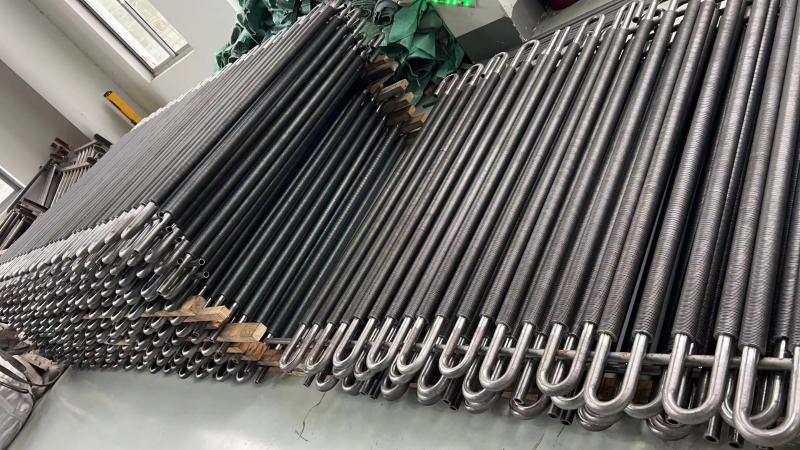
1. Product Overview
Finned tube is a high-efficiency heat exchange component formed by attaching metal fins onto the outer surface of base bare tubes. The fins greatly expand the heat transfer area between the tube medium and air, significantly improving heat exchange efficiency. Ordinary bare tubes have limited heat dissipation capacity when exchanging heat with air; fins solve this weakness by enlarging the contact surface, making finned tubes the core part of all air-to-fluid heat exchange equipment.
The base tube normally carries liquid or gas media (steam, hot water, cold water, thermal oil, refrigerant), while the fins contact ambient air to realize heating, cooling or heat recovery. It features compact structure, stable thermal performance, low energy consumption and long service life, widely applied in HVAC, chemical industry, power plants, metallurgy, food drying and refrigeration fields.
2. Main Types of Fins (Classified by Processing Technology)
2.1 Extruded Integral Finned Tubes
- Manufacturing: Fins and base tube are extruded integrally from a single aluminum alloy tube, no gap between fin root and tube wall.
- Advantages: Zero thermal resistance, excellent anti-corrosion performance, tight bonding, high heat transfer efficiency, anti-fouling, suitable for high temperature and corrosive air environments.
- Disadvantages: Higher production cost, limited maximum fin height.
- Common material: Aluminum 1060 / 3003 base with integral fins.
2.2 Wound (L/LL/KL Type) Finned Tubes
Also called spiral wound fin tubes, the most mainstream industrial type.
- L-type fin: Aluminum strip wound tightly on the steel base tube, fin foot wraps the tube surface. Low cost, suitable for normal temperature working conditions below 120℃.
- LL-type double wrapped fin: Double-layer wrapping at fin root, stronger adhesion, good anti-oxidation, working temperature ≤160℃.
- KL-type knurled fin: Knurling process at tube surface before winding fins, mechanical interlock eliminates air gap between fin and tube. Working temperature up to 220℃, stable heat transfer under high temperature.
- Base tube materials: Carbon steel, stainless steel, copper; fin material: aluminum strip.
2.3 High-frequency Welded Spiral Finned Tubes
- Manufacturing: Steel fin strip is continuously welded onto carbon steel/stainless steel base tube via high-frequency resistance welding.
- Advantages: Metallurgical bonding between fin and tube, ultra-low thermal resistance, withstand high temperature up to 350℃, high pressure resistance, strong mechanical strength, anti-vibration.
- Application: Boiler waste heat recovery, power plant flue gas cooling, high-temperature industrial heat exchangers.
- Matching materials: Carbon steel fin + carbon steel tube; stainless steel fin + stainless steel tube.
2.3 Embedded (G-type) Finned Tubes
- Manufacturing: A spiral groove is pre-machined on the base tube, and aluminum fin strip is embedded into the groove then rolled and locked.
- Advantages: Firm connection, applicable for medium temperature below 250℃, can bear frequent temperature fluctuation.
- Shortcoming: Complex processing, higher price than wound L-type tubes.
2.4 Plate Finned Tubes
Flat metal plates sleeved on straight tubes, arranged in parallel. Widely used in air conditioning evaporators, condensers and small cooling units, mostly copper tube + aluminum plate fins.
3. Main Series of Finished Finned Tube Products
- Heat Exchanger Finned Tubes
Matching air coolers, air heaters, cabinet heat exchangers for factory workshop heating, warehouse heating, fresh air units. - Boiler & Waste Heat Recovery Finned Tubes
High-frequency welded steel fin tubes for economizers, flue gas waste heat recovery devices in power plants, chemical furnaces. - Refrigeration & HVAC Finned Tubes
Copper-aluminum plate fin tubes for air conditioner evaporators, condensers, cold storage air coolers. - Drying Equipment Special Finned Tubes
High heat-dissipation extruded or KL wound fin tubes for food drying, wood drying, textile drying ovens. - Anti-corrosion Stainless Steel Finned Tubes
Stainless steel base tube + stainless steel/aluminum fins, used in chemical corrosive gas, seawater desalination, marine heating equipment.
4. Key Technical Parameters
4.1 Base Tube Parameters
- Common base tube outer diameter: 16mm, 19mm, 22mm, 25mm, 32mm, 38mm, 42mm, 48mm, 57mm
- Tube wall thickness: 1.0mm ~ 6.0mm customizable
- Standard tube length: 1m, 1.5m, 2m, 3m, 4m, 6m; customized length acceptable
- Base tube material options: Carbon steel (20#), stainless steel (304, 316L), copper, seamless alloy steel
4.2 Fin Structural Parameters
- Fin height: 8mm ~ 25mm (customizable for special heat exchange demand)
- Fin thickness: 0.3mm ~ 1.2mm
- Fin pitch (distance between two adjacent fins): 2.0mm, 2.5mm, 3.0mm, 4.0mm, 5.0mm, 6.0mm, 8mm, 10mm
- Fin material: 1060 aluminum, 3003 anti-rust aluminum, Q235 carbon steel, 304 stainless steel
4.3 Working Performance Parameters
- Design working temperature range
- L/LL wound fin tubes: ≤160℃
- KL knurled fin tubes: ≤220℃
- Embedded G-type fin tubes: ≤250℃
- High-frequency welded fin tubes: ≤350℃
- Integral extruded fin tubes: ≤280℃
- Design working pressure: 0.8MPa ~ 6.4MPa (adjustable according to wall thickness and material)
- Heat transfer coefficient: 30 ~ 90 W/(㎡·℃), varies with fin type, air flow speed and medium temperature difference
- Surface treatment options: galvanization, epoxy anti-corrosion coating, passivation, aluminum oxidation to improve rust resistance and service life
5. Core Advantages
- Large extended heat transfer area, high heat exchange efficiency, smaller equipment footprint compared with bare tube heat exchangers.
- Multiple fin types and material combinations to match different temperature, pressure and corrosive working conditions.
- Mature processing technology, stable mechanical strength, anti-vibration, not easy to fall off fins under long-term operation.
- Flexible customization on size, fin density and surface coating to meet personalized industrial equipment requirements.
6. Wide Application Fields
- HVAC & ventilation: workshop heating radiators, fresh air heaters, air conditioning cooling coils
- Energy & power: boiler economizers, flue gas waste heat recovery, power station heat recovery systems
- Chemical industry: chemical reactor coolers, corrosive gas heat exchange, solvent recovery units
- Food & light industry: drying ovens for grain, fruits, textiles, printing and dyeing drying equipment
- Refrigeration & cold storage: evaporative air coolers, freezer heat exchange coils
- Metallurgy & building: industrial kiln cooling, greenhouse heating radiators