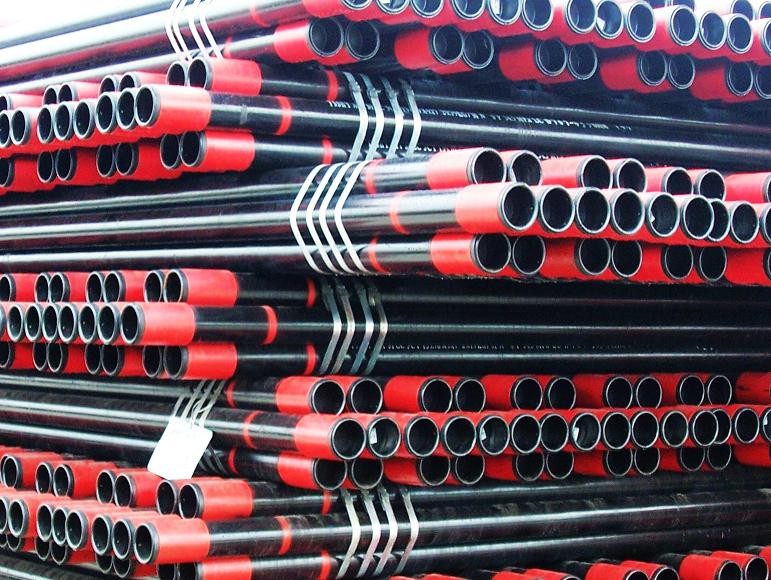
1. Core Standard Background
API Specification 5CT issued by the American Petroleum Institute is the primary global standard for oil country tubular goods (OCTG), covering seamless steel tubing and casing used in oil and gas wells. It specifies dimensional tolerance, steel grades, mechanical properties, manufacturing procedures and inspection requirements for production tubing. The matching thread standard is API Spec 5B, which governs thread profiles, gauging and connection dimensions for tubing joints. Products with API monogram certification strictly follow this system for wellbore interchangeability and downhole safety.
2. Tubing Specifications (Dimensions & End Connections)
(1) Outer Diameter and Wall Thickness
Standard tubing outer diameters range from 1.050 in (26.67 mm) up to 4.500 in (114.3 mm). Corresponding wall thicknesses are listed in the standard tables, with strict dimensional tolerance on OD, wall thickness and straightness.
(2) End Upset Types (Main Connection Forms)
- NU (Non-Upset Tubing / NUE)
No thickening at pipe ends; threaded directly on the original pipe body, matched with standard couplings. It is widely used in shallow, low-pressure wells. - EU (External Upset Tubing / EUE)
Pipe ends are thickened externally before threading, which improves tensile strength and pressure resistance, suitable for medium-deep and high-pressure wells. - IJ (Integral Joint Tubing)
Two pipe ends are machined into pin and box structure without separate couplings, used in compact downhole assemblies.
(3) Length Ranges
Three standard length ranges are defined:
- R1: 6.10 m ~ 7.32 m
- R2: 8.53 m ~ 9.75 m
- R3: 11.58 m ~ 12.80 m
(4) Thread Types
Round threads comply with API 5B. Premium special threads are also available upon buyer-seller agreement to enhance sealing performance in high-pressure and corrosive wells.
3. Material & Steel Grades (Mechanical Classification)
Tubing is manufactured from seamless carbon and alloy steel. The grade number stands for the minimum yield strength in ksi (1000 psi). Grades are divided into four groups according to strength and anti-corrosion performance:
Group 1 (Conventional carbon steel for general service)
- H40: Low strength, for shallow production wells
- J55 / K55: Medium-low strength, the most common grade for conventional oil and gas wells
Group 2 (Corrosion-resistant alloy steel for sour service)
- L80: Standard anti-sulfide stress cracking grade; includes L80-1 and chrome grades such as L80 9Cr and L80 13Cr for CO₂ and H₂S corrosive environments
- C90, T95, C110: High-strength sour-service grades for deep corrosive wells
Group 3 (High-strength carbon/alloy steel for high-pressure deep wells)
- N80 (N80-1 & N80-Q): Widely used in medium-deep high-pressure wells
- P110: High yield strength for deep wells and high-pressure formations
Group 4 (Ultra-high strength)
- Q125: Maximum strength for ultra-deep high-pressure well applications
4. Mandatory Inspection & Supporting Standards
- Chemical composition and mechanical tests (yield strength, tensile strength, hardness and impact toughness) must meet the limits specified in API 5CT.
- Hydrostatic pressure test and non-destructive testing (ultrasonic inspection, eddy current test) are compulsory to detect wall defects.
- Thread machining and gauging shall comply strictly with API Spec 5B.
- Supplementary standards cover coating, coupling material and third-party inspection requirements for sour well tubulars.
Short Version (for product catalog)
Under API Spec 5CT, oil production tubing is seamless OCTG steel pipe with OD from 26.67 mm to 114.3 mm, available in Non-Upset (NU) and External Upset (EU) ends. Main steel grades include J55, K55, N80, L80, C90, T95, P110 and Q125, classified by yield strength and anti-corrosion capacity. Thread processing follows API Spec 5B, with mandatory hydrostatic test and NDT to guarantee downhole pressure containment and structural integrity.