1. Standard Overview & Scope
ASTM B338 is the globally recognized specification issued by ASTM International, fully titled Standard Specification for Seamless and Welded Titanium and Titanium Alloy Tubes for Condensers and Heat Exchangers, also adopted as ASME SB338 for pressure vessel and power industry useASTM International.
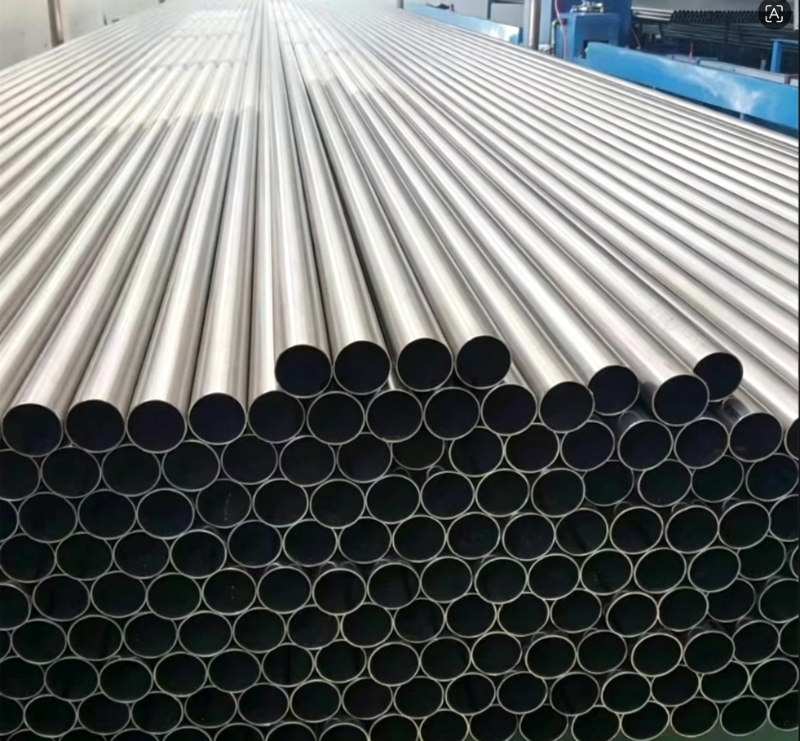
This standard governs 28 grades of seamless and welded titanium tubing exclusively engineered for surface condensers, evaporators, shell-and-tube heat exchangers, and related heat transfer equipment exposed to seawater, brine, acid, chloride and corrosive process fluids. It unifies chemical composition, dimensional tolerances, mechanical performance, manufacturing procedures, mandatory testing, marking and delivery rules for heat-exchange titanium tubes.
Two production forms are defined:
- Seamless Titanium Tube: Manufactured from hollow titanium billets via cold drawing, cold pilgering or cold reducing, with fully continuous metal matrix, higher pressure resistance and uniform corrosion performance.
- Welded Titanium Tube: Rolled titanium strip formed and automatic arc-welded; weld seam must undergo full cold working to recrystallize the cast weld microstructure into equiaxed grains, eliminating weld weakness for heat serviceASTM International.
2. Covered Titanium Grades & Material Classification
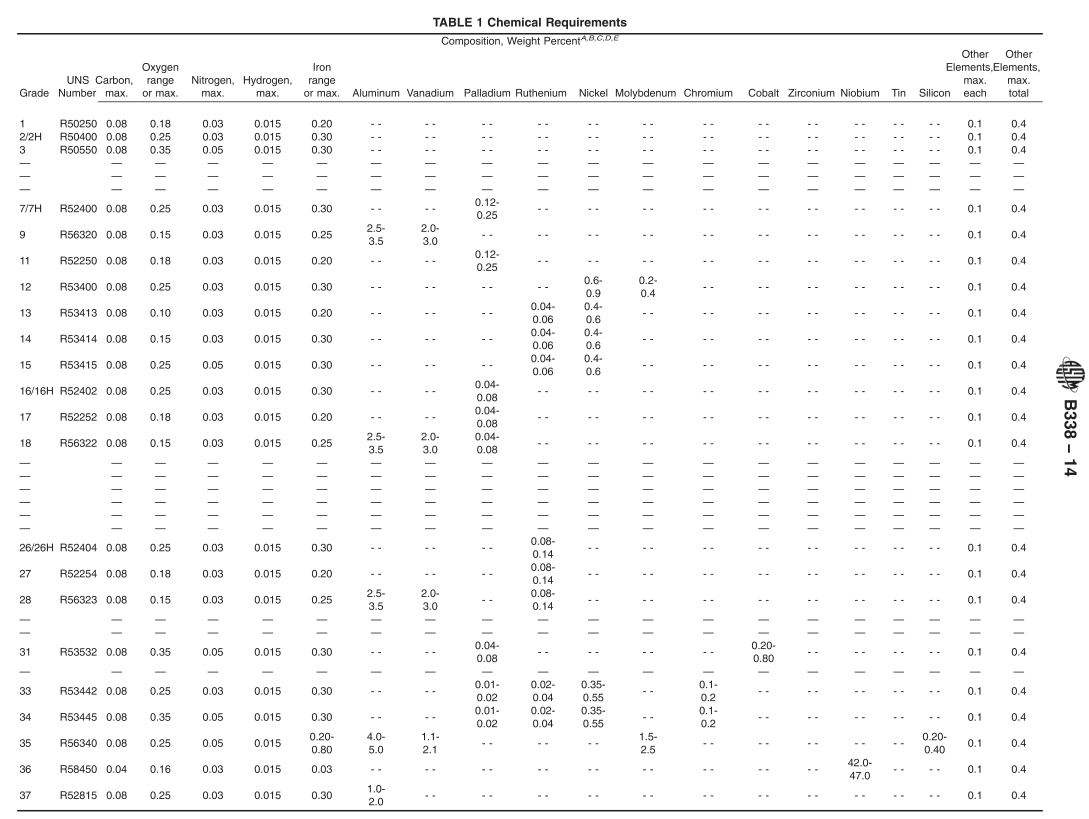
ASTM B338 classifies tubes into unalloyed commercial pure titanium and corrosion-resistant titanium alloys, with fixed UNS numbers and strict element limits for C, Fe, O, N, H and alloy additives. Key mainstream grades:
2.1 Unalloyed Pure Titanium (CP Ti)
- Grade 1 (UNS R50250): Lowest strength, maximum ductility, for mild clean seawater cooling loops
- Grade 2 (UNS R50400): Most widely used general pure titanium; Grade 2H is high-strength variant with minimum 58 ksi tensile strength for higher design pressure
- Grade 3 (UNS R50550): Higher oxygen content, elevated tensile strength for medium corrosive media
2.2 Palladium-Alloyed Anti-Crevice Corrosion Grades
- Grade 7 / 7H (UNS R52400): Ti-0.12~0.25Pd, outstanding resistance to crevice corrosion in stagnant high-chloride seawater and brine
- Grade 11: Lower palladium content, cost-effective alternative to Grade 7 for moderate corrosive conditions
2.3 Nickel-Molybdenum / Ruthenium Alloys (Sour & Brine Service)
- Grade 12 (UNS R53400): Ti-0.3Mo-0.8Ni, excellent resistance to hot salt brine, H₂S and CO₂, widely used in offshore oilfield heat exchangers
- Grade 13/14/15: Ti-Ni-Ru series, superior anti-SSC performance for high-temperature acidic formation water
2.4 Medium-Strength Structural Alloy
- Grade 9 (UNS R56320, Ti-3Al-2.5V): Dual-phase alloy with balanced strength and formability, for high-pressure compact heat exchange bundles
3. Dimensional Specifications & Tolerances
ASTM B338 standardizes tube outer diameter (OD), wall thickness (WT), length and strict dimensional tolerances for heat exchanger tube bundles:
- Outer Diameter: Common heat-exchanger sizes range from 6.35 mm (1/4 in) to 50.8 mm (2 in); OD tolerance ±0.102 mm for OD below 25.4 mm, ±0.127 mm for OD 25.4–38.1 mm.
- Wall Thickness: Typical WT 0.7 mm–5.0 mm; minimum wall thickness guaranteed (+20%/-0 tolerance), critical for anti-puncture under differential pressure.
- Length: Standard random lengths 4–15 m; fixed cut lengths available per purchaser request, with length deviation ±3 mm per 3 m.
- Straightness & Ovality: Tubes must meet straightness limits to ensure smooth tube sheet expansion during heat exchanger assembly.
4. Mandatory Mechanical Property Requirements
All tubing shall pass room-temperature tensile tests to meet grade-specific minimum tensile strength, 0.2% offset yield strength and elongation (2 in gauge length):
- Grade 2 CP Ti: Min tensile 50 ksi (345 MPa), min yield 40 ksi (275 MPa), min elongation 20%
- Grade 2H High-strength Ti: Min tensile 58 ksi (400 MPa), same yield and elongation as Grade 2
- Grade 12 Ti-Mo-Ni alloy: Min tensile 70 ksi, for high-pressure corrosive heat transfer circuits
Hardness and bend test requirements are also specified for welded tubes to verify weld ductility and homogeneity.
5. Chemical Composition Control
Strict impurity ceilings are enforced for all grades to avoid hydrogen embrittlement and intergranular corrosion:
- Max Carbon: 0.10%; Max Iron: 0.30%; Max Nitrogen: 0.03%; Max Hydrogen: 0.0125%
- Oxygen content tightly controlled to balance ductility and mechanical strength; alloy grades require precise Pd, Mo, Ni, Al, V ratios within narrow ranges.
6. Mandatory Inspection & NDT Tests
ASTM B338 mandates full non-destructive and hydraulic testing for every tube before deliveryASTM International:
- Hydrostatic / Pneumatic Test: Each tube pressurized to specified design pressure to detect through-wall leaks.
- Electromagnetic Eddy Current Test: 100% inspection for surface cracks, pits and wall thickness variation.
- Welded tube extra tests: Weld cross-section metallography to confirm fully recrystallized weld microstructure.
- Batch sampling: Tensile test, chemical analysis, bend test for every production heat lot for traceability.
7. Core Advantages & Typical Applications
Key Material Advantages of ASTM B338 Titanium Tubes
- Exceptional chloride corrosion resistance, immune to seawater pitting and crevice corrosion (superior to copper alloy and stainless steel)
- Light weight (40% lighter than steel) with high specific strength
- Stable performance under wide temperature range (-50 ℃ ~ 300 ℃)
- No heavy metal ion precipitation, long service life over 20 years for marine heat exchange equipment
Main Application Scenarios
- Power industry: Coastal thermal power and nuclear power plant surface condensers
- Desalination: Multi-effect distillation and reverse osmosis heat exchange tube bundles
- Offshore oil & gas: Platform process coolers, seawater injection heat exchangers, sour brine cooling circuits
- Chemical & chlor-alkali: Acid, chlorine and salt solution heat transfer equipment
- Marine engineering: Shipboard seawater cooling condensers
8. Marking, Certification & Supplementary Standards
- Permanent marking on each tube: ASTM B338 grade, UNS number, seamless/welded, heat number, OD × WT, manufacturer logo for full traceability.
- Material test report (MTR) mandatory for shipment, covering chemical composition, tensile data and NDT records.
- Matching supporting standards:
- ASTM B265: Titanium plate for heat exchanger tube sheets
- ASME BPVC Section II-D: Allowable stress design reference for pressure equipment
- ASTM B861 / B862: General-purpose seamless/welded titanium tubes beyond heat exchanger service