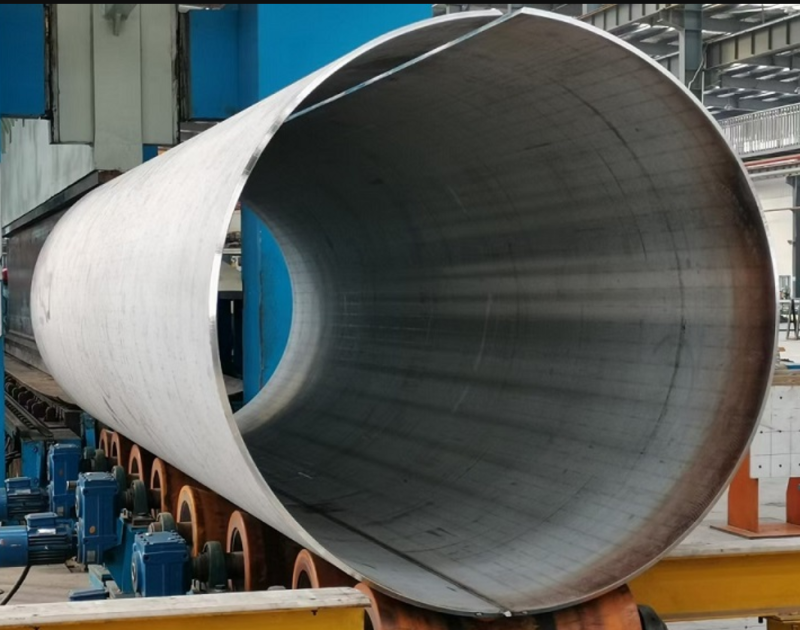
1. Manufacturing & Structural Features
LSAW stands for Longitudinal Submerged Arc Welded Steel Pipe. It is fabricated by bending thick steel plates into a cylindrical shape and performing single straight longitudinal submerged arc welding on the joint.
- Only one straight weld seam runs parallel to the pipe’s axial direction, far shorter than the spiral weld of SSAW pipes, which reduces potential weld defect risks.
- Double-sided submerged arc welding (inside and outside weld passes) delivers dense, uniform weld metal with minimal porosity, slag inclusion or cracking.
- Raw material is heavy flat steel plate instead of steel coil, enabling production of heavy-wall pipes for high-pressure service.
- The straight weld aligns with hoop stress distribution under internal pressure, providing stable burst resistance.
2. Dimensional Advantages
Outer Diameter Range
Covers NPS 14 to NPS 64 (OD 355.6 mm – 1626 mm), filling the gap between large seamless pipes and extra-large SSAW pipes.
Wall Thickness Capacity
Supports heavy wall thickness from 6 mm up to 60 mm, much thicker than standard SSAW pipes, ideal for high-pressure trunk lines and deep-buried projects.
Dimensional Precision
Tight tolerances for roundness, straightness and wall thickness; uniform inner and outer surfaces with low fluid flow resistance.
Standard Length & Ends
Factory fixed lengths of 12 m, double random lengths, customizable cut lengths; pipe ends are precision bevelled for reliable field circumferential welding.
3. Mechanical Performance Characteristics
- High pressure-bearing capacity
Thick plate base metal plus high-integrity straight weld meets strict API 5L PSL2 standards for high-strength grades X65, X70, X80, suitable for long-distance high-pressure oil & gas transmission. - Excellent low-temperature toughness
Steel plates adopt thermo-mechanical controlled rolling (TMCP) technology. Products pass mandatory Charpy V-notch impact and DWTT tests, resisting brittle fracture in frigid regions. - Stable weld matching performance
Weld tensile strength, yield strength and ductility fully match the parent steel plate, avoiding premature failure at weld joints under cyclic pressure loads. - Outstanding anti-extrusion capacity
Heavy wall design tolerates heavy overburden soil pressure, ground settlement and external impact for deep buried trunk pipelines.
4. Quality Inspection & Safety Features
- Full-length non-destructive testing (UT ultrasonic, RT radiographic inspection) is mandatory for the single longitudinal weld seam to eliminate hidden defects.
- Compliant with strict API 5L PSL 2 test standards: full chemical analysis, tensile, flattening, hydrostatic pressure and impact tests for critical energy projects.
- Each pipe carries complete heat number traceability records for engineering quality tracking.
5. Production & Application Matching Traits
- Premium reliability for critical energy projects
Compared with SSAW, shorter weld length means fewer potential failure points; LSAW is the primary choice for national cross-country high-pressure oil and gas trunk lines. - Wide anti-corrosion compatibility
Perfectly adaptable to 3PE, FBE external anti-corrosion coatings and internal epoxy lining for buried offshore and onshore pipeline systems. - Flexible project adaptability
Can be customized for sour service (HIC-resistant steel plate) to transport sour crude and acid natural gas with strict anti-cracking requirements.
6. Limitations
- Higher production cost than SSAW due to expensive thick steel plate raw materials and complex plate forming processes.
- Not cost-effective for small-diameter, thin-wall municipal pipelines where ERW or SSAW are more economical alternatives.
7. Summary Paragraph
LSAW longitudinal submerged arc welded steel pipe is manufactured from heavy steel plates with a single short straight weld seam via double-sided submerged arc welding. It features heavy wall thickness capacity, precise dimensional control, superior low-temperature toughness and high pressure-bearing performance, fully complying with API 5L PSL2 strict quality standards. With fewer weld defects and stronger structural safety than SSAW, it serves as the premium large-diameter pipe solution for high-pressure long-distance oil, natural gas trunk lines, offshore subsea pipelines and cold-region energy transmission projects, despite higher manufacturing costs.